
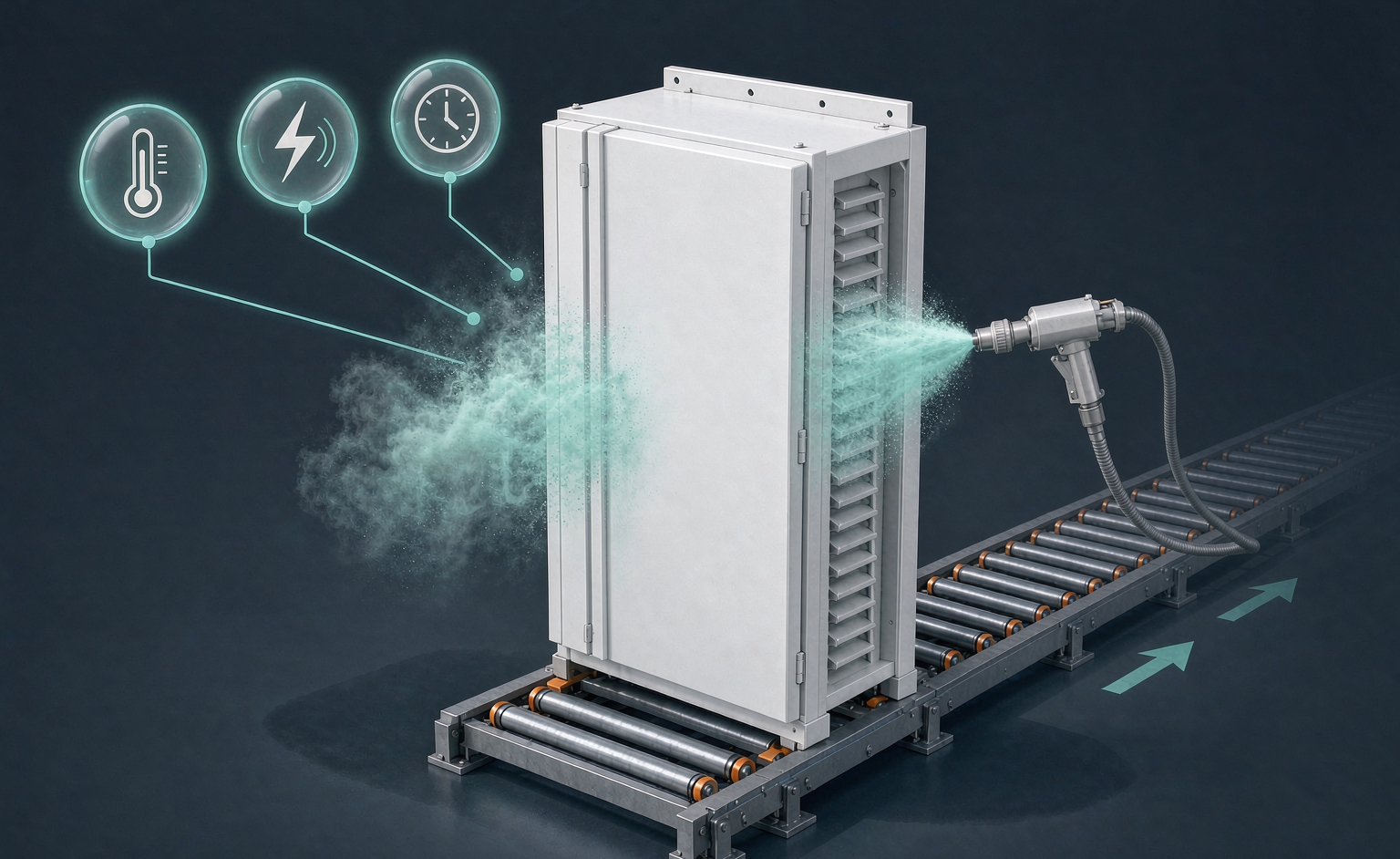
Introduction: A custom 120°C low bake epoxy powder can lower substrate peak temperature and oven energy load for thick steel parts, energy storage cabinets, and heat-sensitive metal components.
Process engineers at energy storage cabinet, thick-steel, and heat-sensitive metal manufacturers often reach the same point: a standard 200°C cure works on thin panels but becomes slow, costly, or risky on heavy weldments and large cabinets. Thick steel absorbs heat unevenly. Energy storage cabinets combine different gauges, ribs, inserts, and sometimes heat-sensitive hardware. The practical question is when a custom 120°C cure is worth testing and what to confirm before sampling. The answer starts with substrate temperature, then moves through film thickness, application method, and a production-like trial.
When a 120°C Low Bake Epoxy Powder Makes Sense for Thick Steel Parts
A 120°C low bake epoxy powder makes sense when substrate temperature is the bottleneck. Oven air may reach 200°C quickly, but a thick steel section can take much longer to reach that temperature at the core, flange, or weld. The powder cures correctly only when the metal itself reaches the required cure window. VeriCoating EP0S-320024 is a pure epoxy powder with a published standard cure of 200°C x 10 min at substrate temperature. It can be customized to a minimum 120°C cure. The 120°C cure is a custom formulation made on request. Lower peak temperature can reduce heat-up time, protect heat-sensitive areas, or lower oven energy demand on heavy parts.
1. Why Thick Steel Parts Need Lower Substrate Peak Temperature Control
Thick steel has high heat capacity. A 10 mm plate, heavy bracket, or dense weldment absorbs a large amount of heat before its core reaches the same temperature as the oven air. If the coating cures on the surface while the core is still climbing, the part may spend unnecessary time in the oven, and the line may struggle to hold a stable cure window. Dropping the peak substrate temperature from 200°C to 120°C changes that equation. The part does not need to absorb as much heat, so heat-up time can be shorter and the thermal gradient across the part can be less severe. For parts with machined faces, threaded inserts, or pre-installed components that should not see high heat, lower peak temperature can be a practical advantage. The exact 120°C holding time still needs engineering confirmation before sampling because thick parts and different oven designs behave differently.
2. How Energy Storage Cabinet Production Lines Reduce Oven Energy Load
Energy storage cabinet production often involves large enclosures, reinforcing ribs, mounting plates, and internal supports. These parts may not be as thick as a heavy weldment, but their total mass and surface area can still pull a lot of heat from the oven. At 200°C, every cycle spends energy heating the steel, the racks, and the oven itself. A custom 120°C cure can reduce that load by lowering the target substrate temperature. It may also shorten the heat-up stage, which helps when the oven is the bottleneck or the line runs multiple colors and changeovers. The gain depends on part mass, rack loading, oven recovery, and the confirmed cure schedule. Profile the part, not just the oven display, then compare the 120°C custom formula against the standard 200°C cure under real production conditions.
How Film Thickness and Application Method Affect Energy Storage Cabinet Coating
VeriCoating EP0S-320024 supports a film thickness range of 60–500 μm, giving process engineers room to design for edge coverage, corrosion barrier, and surface build. On energy storage cabinets, a thicker film can improve coverage over sharp edges and welded seams. Thickness alone is only one factor; the application method determines how evenly the powder deposits, how well it reaches recesses, and how much film builds on edges versus flat panels. Manual or automatic electrostatic spray is supported. Fluidized-bed dip coating is possible by prior agreement, and triboelectric spraying also needs advance agreement. High film thickness depends on the application method and part geometry, so the same powder can behave differently on a flat door panel than on a complex frame with overlapping surfaces. Match the coating plan to the cabinet’s function. An interior pure epoxy layer may provide chemical resistance and barrier protection, while an outdoor or high-visibility surface may need a compatible topcoat system. If the cabinet will see both, the primer and topcoat need to work together. Application method also affects cycle time. Automatic electrostatic spray suits high-volume flat panels and simple profiles. Manual spray gives operators more control in recesses and around masked areas. Fluidized-bed dip can build high thickness on preheated parts, but it requires the right part design and an agreed process. Safety practices for electrostatic powder coating, including grounding, ventilation, and dust control, remain part of the line design. Choose a thickness and method that the oven, conveyor, and part geometry can support consistently.
How to Move from Low-Temperature Inquiry to Sample Testing
The fastest way to evaluate a 120°C low bake epoxy powder is to treat it as a process project, not just a material purchase. Start with the part data: material, steel thickness, overall mass, geometry, maximum allowable substrate temperature, oven type, conveyor speed, target film thickness, application method, color, and finish. If the part contains heat-sensitive components, note their temperature limit. Share this information with powder coating manufacturers. If you source through powder coating powder suppliers, include the same data in the inquiry. Then ask for engineering review of the 120°C cure schedule. VeriCoating EP0S-320024 is customized to a minimum 120°C cure, but the exact holding time is worth checking by engineering before sampling. The standard 200°C x 10 min cure data provides a useful baseline: it shows what the coating normally needs, and the custom formula is developed against the part and oven conditions. Sample testing should reproduce the production line as closely as possible. Use the same substrate, pretreatment, application method, and film thickness range. Measure substrate temperature on the part, not just the oven air. After cure, check appearance, adhesion, impact resistance, hardness, and coverage on edges and recesses. EP0S-320024 provides GT0 adhesion, 50 kg·cm impact resistance, ≥H pencil hardness, and 1000-hour neutral salt spray performance in single-layer C2–C4 conditions. These benchmarks help compare a trial panel against the current coating. If the trial looks good, the next step is a small production batch. The MOQ for bulk orders is 100 kg, regular batches ship in 1–7 working days, and packaging is 20 kg or 25 kg. Samples are free as material, arranged within 72 hours, with international freight paid by the buyer under EXW terms. Before ordering, confirm the final cure schedule, packaging, lead time, and freight responsibility.
Conclusion
A custom 120°C low bake epoxy powder is worth evaluating when thick steel parts, energy storage cabinets, or heat-sensitive components make a 200°C cure slow, costly, or risky. The decision should follow the part: substrate mass, geometry, oven behavior, film thickness, and application method. VeriCoating EP0S-320024 provides a clear baseline with its standard 200°C x 10 min cure and a custom 120°C option on request. It supports 60–500 μm films, manual or automatic electrostatic spray, and fluidized-bed dip coating by prior agreement. To move forward, send the part drawings, oven profile, target film thickness, and application method to a technical contact. Confirm the 120°C holding time, request a sample, and test it under production-like conditions before committing to a 100 kg batch.
FAQ
Q: Is 120°C low bake epoxy powder coating a standard stock product or a custom formula?
A: It is a custom formula. VeriCoating EP0S-320024 has a published standard cure of 200°C x 10 min at substrate temperature and can be customized to a minimum 120°C cure. The exact holding time for 120°C is worth checking by engineering before sampling because it depends on the part, oven, and film thickness.
Q: Can low temperature cure epoxy powder be used for energy storage cabinets and thick steel parts?
A: It can be suitable when lower substrate peak temperature helps thick sections, large cabinets, or heat-sensitive components. It supports 60–500 μm film thickness, manual or automatic electrostatic spray, and fluidized-bed dip coating by prior agreement. For outdoor exposure, use a pure epoxy layer as part of a compatible coating system rather than as a standalone finish.
Q: What should I confirm before requesting a 120°C epoxy powder sample?
A: Confirm the steel thickness and part geometry, maximum allowable substrate temperature, oven type and loading, target film thickness, application method, color, and expected order quantity. Also confirm the 120°C holding time with engineering, the 100 kg MOQ for bulk orders, the 1–7 working-day lead time for regular batches, and that samples are free as material with international freight paid by the buyer under EXW terms.
Sources / References
Protective coatings - a guide to project delivery - The Australasian Corrosion Association Ltd
Model Code of Practice: Spray painting and powder coating - Safe Work Australia
Incoterms® 2020 - ICC - International Chamber of Commerce