
Introduction: Pure epoxy and polyester powder coatings can look identical once cured, yet their resin chemistry pushes them toward completely different parts and service conditions.
An indoor machine frame wiped down with solvent every shift and an outdoor equipment housing sitting in direct sun look like similar coating jobs from the outside. They are not. The resin system inside the powder decides how the cured film responds to oils, cleaning agents, and ultraviolet light, and those three stressors pull in different directions. Choosing between pure epoxy and polyester is really a question about which chemistry matches the exposure, not which resin is stronger in some absolute sense. Getting that boundary right prevents the most common mismatch in industrial finishing: an epoxy film asked to survive years of sunlight, or a polyester film asked to shrug off repeated solvent contact.
How Epoxy and Polyester Resins Differ in Cross-Linked Films
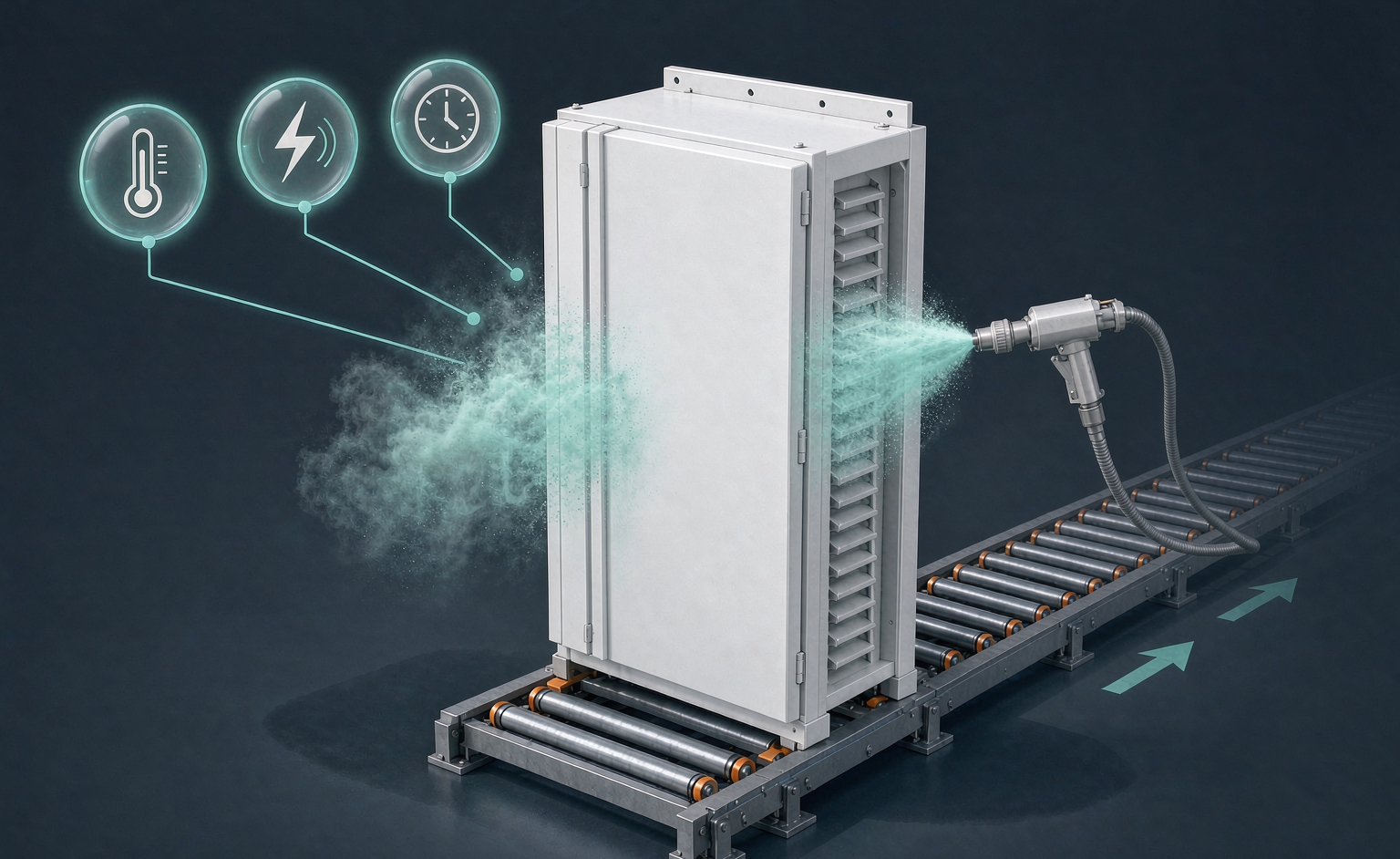
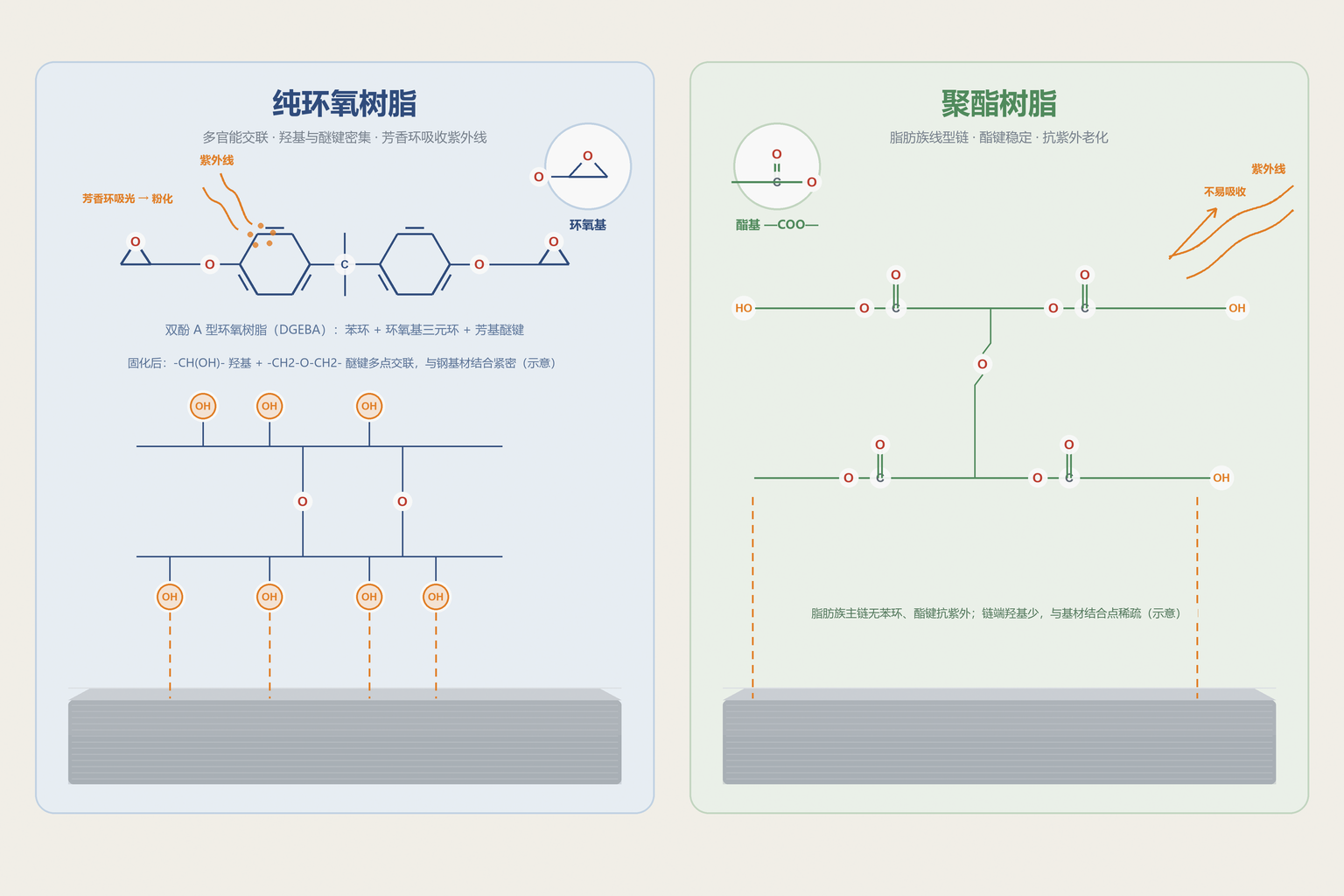
Both coatings arrive as dry powder and behave almost the same through the booth. The powder is sprayed electrostatically onto a grounded part, melts in the oven, flows into a continuous film, and then cross-links into a thermoset network. Everything that happens after cure — chemical resistance, adhesion, weatherability — traces back to the resin backbone and the cross-linker that locks it together. Epoxy powder uses a bisphenol-based backbone carrying epoxide groups, cured with agents such as dicyandiamide, phenolic resins, or anhydrides. Opening those epoxide rings during cure builds a tight three-dimensional network with a high concentration of polar hydroxyl and ether groups along the polymer chains. Polyester powder starts from hydroxyl- or carboxyl-terminated polyester chains and connects them with a cross-linker such as TGIC, HAA, or a blocked isocyanate. Its backbone is built on ester linkages, and the cured network carries far fewer polar groups. Powder coating manufacturers work from exactly these platforms because the structural difference drives almost every practical contrast between the two materials. A dense, polar epoxy network wets a properly prepared steel surface well, grips it, and forms a strong barrier against moisture and dissolved ions trying to reach the metal underneath — the same barrier logic that makes epoxy matrices useful in aggressive chemical environments. The trade-off is that the aromatic ether structure behind those polar groups absorbs ultraviolet light. Polyester's aliphatic ester backbone is much less sensitive to UV-driven breakdown, which is why polyester systems dominate outdoor architectural and equipment finishes. Industrial protective coating guidance treats service environment as the first selection variable for this reason: the film has to match the exposure, and no single resin wins across every condition.
Why Indoor Chemical Exposure Changes the Material Choice
Walk through a typical indoor industrial plant and the failure drivers look different from outdoors. Sunlight is scarce, while cutting fluids, hydraulic oil, degreasers, and alkaline wash-down cleaners are everywhere. A coated part inside a facility is more likely to be judged by how it handles a solvent spill, a daily wipe-down, or a shifting mechanical load than by how it looks after five summers. That shift in stressors is what pushes indoor parts toward pure epoxy and away from a weatherability-first choice.
1. Chemical Resistance Depends on Resin Polarity and Cross-Link Density
Chemical resistance in a cured powder film comes down to two things: how tightly the network is cross-linked, and how the polymer chains interact with whatever is attacking them. A highly cross-linked epoxy network leaves little free volume for solvent molecules to slip between chains, and its polar groups bond readily to a prepared metal surface, so aggressive liquids have a harder time creeping along the coating-substrate interface. Strong alkaline cleaners attack ester linkages through hydrolysis, which is why polyester films can dull or soften under repeated caustic exposure. Epoxy is not invulnerable — concentrated acids and some ketones will still attack it — but across the everyday mix of oils, coolants, and general-purpose cleaning agents found indoors, the epoxy network holds up noticeably longer.
2. Indoor Parts Often Face Oils, Solvents, and Cleaning Agents
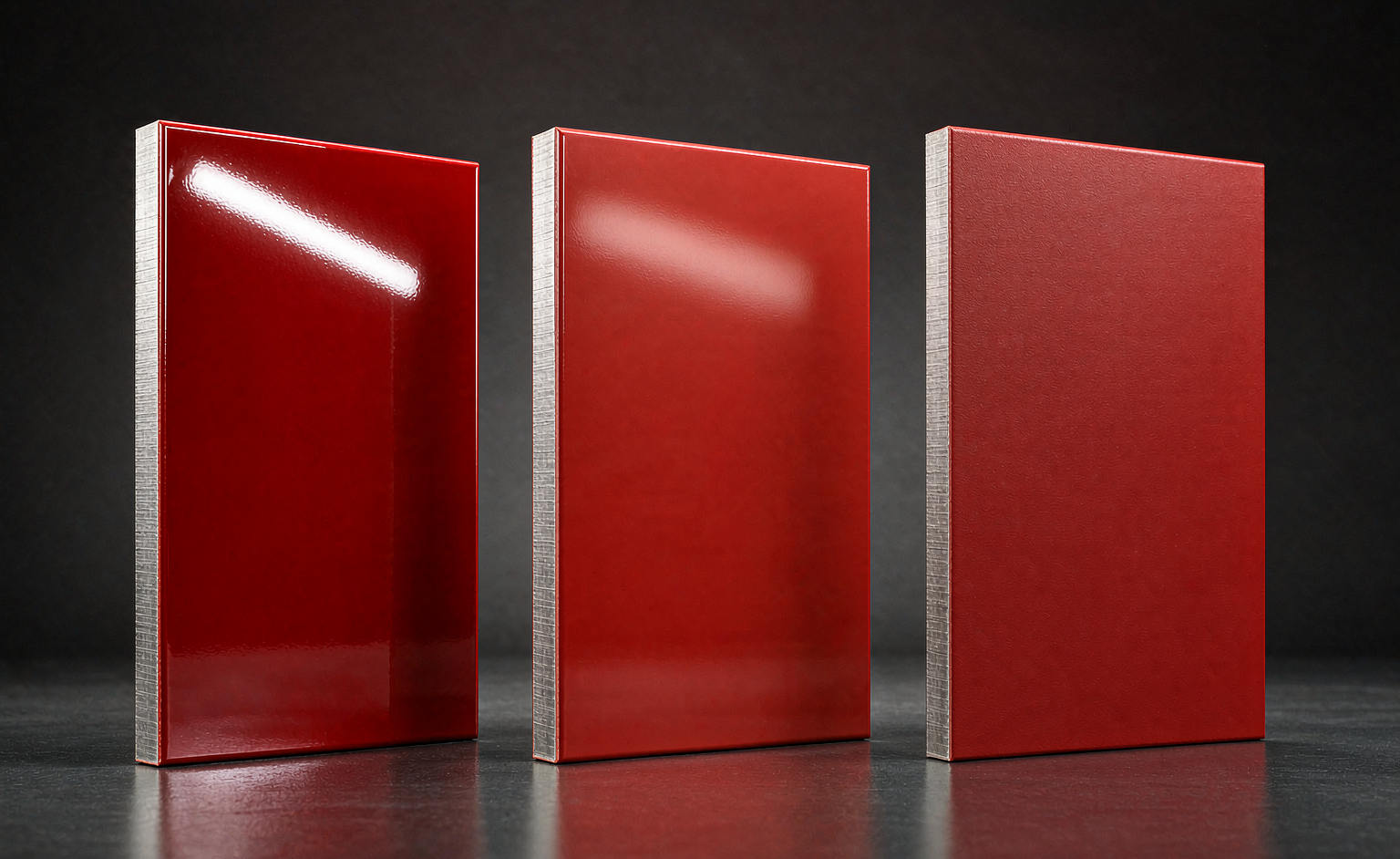
Think about the components that actually live inside a plant: machine frames, pump and motor housings, tooling, electrical enclosures, shelving in a wash-down zone, and functional parts on a production line. These pieces are rarely punished by UV, but they sit in constant contact with process fluids and cleaning chemicals. An interior pure epoxy coating such as VeriCoating RAL 3001 EP0S-320024 is formulated for exactly that world: a smooth semi-gloss signal red finish that can be applied from 60 to 500 μm, with single-layer 1000-hour neutral salt spray performance. It is an indoor reference point rather than a standalone outdoor weatherable coating, and mixing those two roles is where most material selection mistakes begin.
Where Polyester Becomes the Better Surface for Outdoor Light
Move the same part outdoors and the ranking flips. Ultraviolet radiation in sunlight carries enough energy to break chemical bonds, and the aromatic groups that give epoxy its strength and polarity are precisely where that damage starts. The visible result is surface degradation: the film loses gloss and develops a chalky top layer. The coating does not usually disappear, but appearance, color retention, and long-term barrier quality all decline. Polyester is engineered around this problem. Its aliphatic ester backbone and cross-linkers such as TGIC or HAA resist UV-driven radical reactions, so a standard, high-durable, or super-durable polyester film can hold its color and gloss over years of direct exposure. The two systems are not interchangeable, and the reason is direction of protection rather than quality. Epoxy is optimized to resist chemicals and to bond aggressively to metal; polyester is optimized to survive sunlight. A solvent-resistant epoxy can still chalk within a couple of outdoor seasons, and a UV-stable polyester can soften under repeated contact with certain aggressive solvents or strong alkaline cleaners that epoxy handles without trouble. When an outdoor part genuinely needs both a chemical barrier and UV stability, the answer is usually a coating system rather than one resin: an epoxy primer protected by a polyester topcoat. That layered approach is a separate design decision, and it is not the same as asking a single layer of pure epoxy to do an outdoor job on its own.
Conclusion
Pure epoxy and polyester powder coatings split along a clear line. Epoxy's dense, polar network delivers the adhesion, barrier strength, and chemical resistance that indoor industrial parts need, which is why machine frames, enclosures, and fluid-exposed components so often use interior pure epoxy finishes such as the RAL 3001 EP0S reference. Polyester's UV-stable ester backbone is what keeps color and gloss intact under direct sunlight, which is why it dominates outdoor surfaces. Neither resin is universally better; the question is always which exposure the part actually faces. Checking that first, before looking at color or gloss level, prevents the expensive mismatch of applying the wrong chemistry to an otherwise correct part. Readers who want to see how an interior pure epoxy specification is published can review the EP0S series listing directly.
FAQ
Q: What is the main difference between pure epoxy and polyester powder coatings?
A: The difference sits in the resin backbone and cross-linker. Pure epoxy builds a tight network with many polar hydroxyl and ether groups, which gives strong metal adhesion and good resistance to oils, solvents, and cleaning agents. Polyester uses an aliphatic ester backbone cross-linked with TGIC, HAA, or a blocked isocyanate, which resists UV-driven breakdown far better. In short, epoxy is the chemical-resistance and barrier performer, while polyester is the sunlight-and-color-retention performer.
Q: Are pure epoxy powder coatings suitable for outdoor industrial parts?
A: Not as a standalone weatherable coating. Sunlight drives surface degradation on a pure epoxy film, so gloss and color drop off over outdoor exposure. For outdoor service, the usual answer is a coating system where an epoxy layer provides the barrier and a polyester topcoat provides the weather-resistance, or a polyester system on its own. Pure epoxy is at its best on indoor parts, or in roles where something else protects it from direct light.
Q: Why do indoor industrial parts often use pure epoxy powder coatings?
A: Because indoor failure modes are chemical and mechanical rather than solar. Machine frames, pump housings, tooling, and enclosures inside a plant meet cutting fluids, hydraulic oil, degreasers, and alkaline cleaners on a routine basis, and they rarely see meaningful UV. Epoxy's high cross-link density and polar backbone handle that chemical load and grip prepared steel tightly, which keeps the coating intact where a weatherability-first resin might soften or stain.
Sources / References
Ionic Porous Organic Polymers Based on Functionalized Tetraarylborates
Related Examples
RAL 3001 EP0S-320024 Interior Pure Epoxy Powder Coating