

Introduction: Gloss changes how Signal Red reads on the shop floor, and inspectors can judge semi-gloss appearance without a meter once they know what to look for.
Stand at the end of a coating line and look at two panels finished in the same RAL 3001 Signal Red coating — one catching daylight from a skylight, one sitting in flat warehouse light. They can read as two different reds even though the same pigment went into both. That is the everyday puzzle with gloss: it is not part of the color, yet it changes how the color appears to anyone standing in front of the part. Three things explain most of it — the gloss range behind a smooth semi-gloss finish, why surface smoothness often matters more than shine on metal parts, and how an inspector reads semi-gloss on the floor without reaching for a gloss meter.
How Gloss Level Shapes the Look of Signal Red
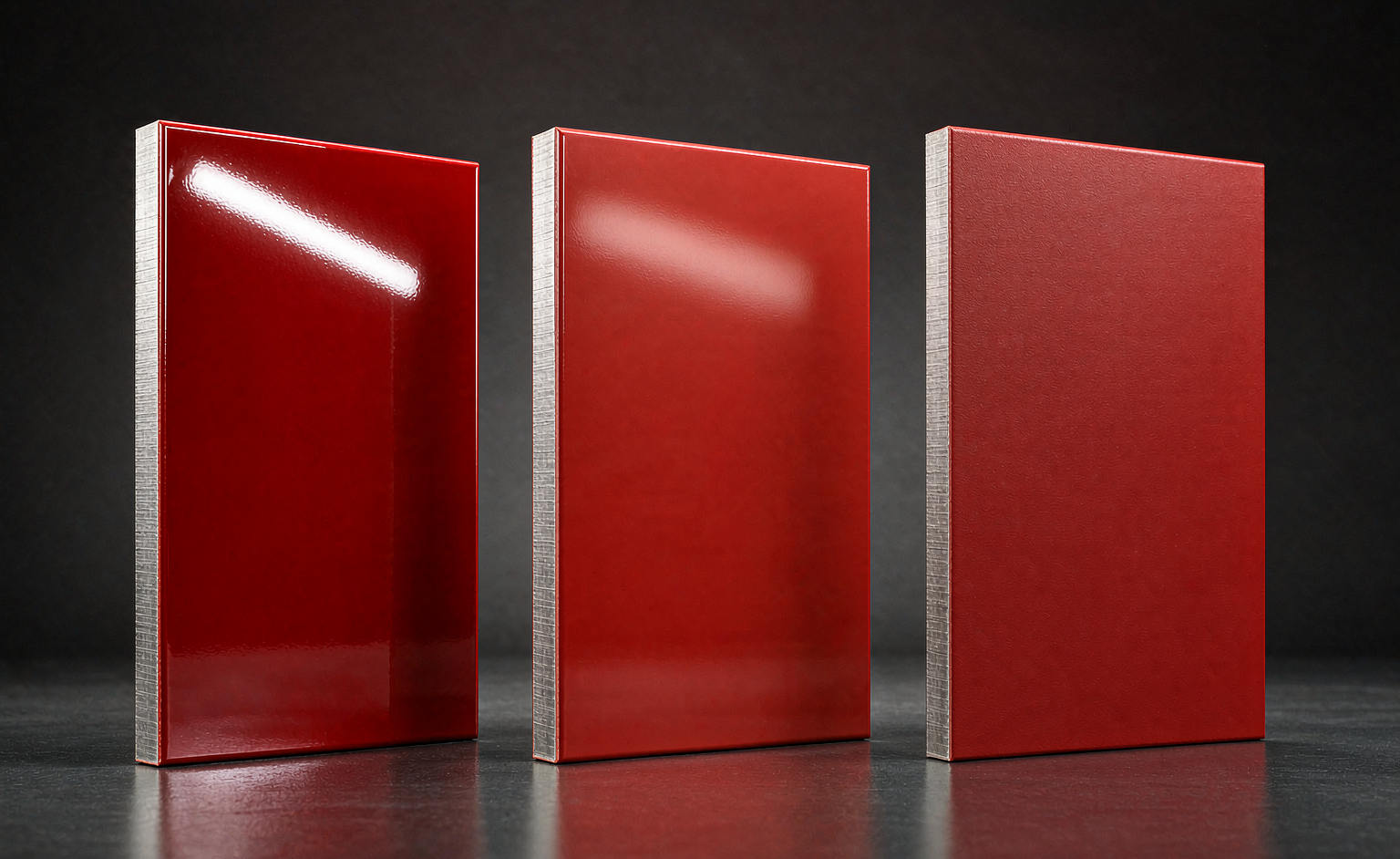
Gloss is measured in gloss units, or GU, and it describes how much light bounces off a surface at a defined angle. The 60° geometry is the usual setup for mid-range finishes, which is why semi-gloss values are normally quoted at 60°. VeriCoating's RAL 3001 EP0S-320024 smooth semi-gloss product is specified at 40–80 GU at 60°, which is a product-specific example rather than a universal definition of semi-gloss. Signal Red itself is a saturated safety red, and saturated colors show reflections harder than muted ones, so the gloss level on a red part shifts the reading more than it would on a beige or grey part. The three common finish families behave differently under the same light. On high gloss, a ceiling fixture or a window edge appears as a near-mirror image, and that bright band locally washes out the red beneath it. On semi-gloss, the same reflection spreads into a soft, wide sheen, so the red stays readable from most angles and most positions on the floor. On matte, the reflection almost disappears, but the surface scatters light broadly and the color can read slightly flatter or dustier — same pigment, different perceived tone. Ambient light level, viewing angle, and the direction you face the part all move the result, which is why a single glance is a poor basis for a gloss call. Printed RAL swatches add to the confusion, because a paper chip has no reflective surface and cannot show you what a glossy red film will do under a strip light.
Why Smoothness Matters More Than Shine on Metal Parts
Gloss and smoothness are usually discussed together, but they are separate properties. A film can be semi-gloss and glass-smooth, semi-gloss and lightly orange-peeled, or high gloss with a gentle wave running across it. Gloss describes how much light reflects; smoothness describes the microscopic flatness of the surface doing the reflecting. What an inspector actually sees on a metal part is the two combined, and that combination is what the eye judges first. On a smooth semi-gloss film, the sheen is even across the whole part. Tilt the panel and the reflection band moves predictably; the red reads the same at the center and out at the edges. Where the film is uneven — thinner at a corner, heavier in a low spot, or holding a little orange peel — light scatters differently from point to point, and the color looks patchy even though the pigment is identical everywhere. Film build sits behind a lot of this. A well-levelled, adequately thick film tends to read smoother, while very thin areas can telegraph the substrate underneath and break up the reflection. Two panels from different powder coating powder suppliers can both be labelled semi-gloss and still read differently on the same rack. That gap is usually about surface quality rather than the gloss number. A glossy but uneven panel and a smoother panel at the same meter reading will not look equally well finished, and experienced buyers notice the difference before they notice the number. Protective coating guides treat appearance as a project-delivery item alongside adhesion and film thickness for exactly that reason: the surface is what a customer inspects first, and it is the first thing that gets argued about at handover. Gloss preference is not a ranking of quality — a deliberately matte part can be a perfect part — but visual uniformity is where the eye lands.
How Inspectors Read Semi-Gloss Without a Gloss Meter
A gloss meter produces a number, and the number needs the right geometry, a flat surface, and a clean film before it means much. On the floor, most semi-gloss calls are made by eye against a known reference, using the same habits every time.
• Compare against a kept reference sample, not memory. Hold the new part and the approved sample side by side under the same light at the same tilt. Semi-gloss can drift half a step across a production run without anyone noticing from memory, and a direct side-by-side catches that drift early.
• Move the light, not the part. Rotate a lamp or walk around the panel and watch the reflection band. A semi-gloss surface throws a soft, wide band that fades out gently. A high-gloss surface throws a sharp edge you can trace with your eye. That contrast shows up clearly without any instrument.
• Watch what reflects in the film. Look for recognizable shapes — a window, a strip light, a person walking past. On high gloss they appear as clear silhouettes. On semi-gloss they soften into blurs. On matte they mostly vanish, leaving a flat color field.
• Sweep the whole part, not just the center. Run your eye edge to edge and look for sections that read lighter, darker, or duller than the rest. Those patches usually point to film build or texture variation rather than a pigment problem.
Conclusion
Gloss is a lighting story as much as a coating story. It changes how Signal Red reads without changing what went into the film, and it sits on top of a separate question — how smooth the surface actually is. Semi-gloss is a useful middle ground for metal parts: enough sheen to reveal a clean, uniform surface, not so much that every reflection competes with the color. Judging it by eye is a learnable skill, and it works best when the comparison is direct, the light is controlled, and the whole part is scanned rather than just the middle. Powder coating manufacturers and coating powder suppliers quote a gloss range for a reason, but that range is only a starting point. What the finished part looks like under real light is what the person receiving it will judge.
FAQ
Q: What does semi-gloss mean for RAL 3001 powder coating?
A: Semi-gloss means the cured film reflects light moderately rather than sharply or not at all, sitting between matte and high gloss. For a RAL 3001 Signal Red coating, that middle range keeps the red saturated while softening reflections, so the color stays readable from most angles. The VeriCoating RAL 3001 EP0S-320024 smooth semi-gloss product is specified at 40–80 GU at 60°, a product-specific example rather than a fixed industry band. Gloss is always measured at a defined angle, so a value without its geometry says very little.
Q: How can I tell smooth semi-gloss from high-gloss on Signal Red metal parts?
A: Look at what reflects in the film. On a high-gloss panel, a window or strip light appears as a sharp, recognizable shape with a traceable edge. On semi-gloss, the same source softens into a wide, blurred sheen. Then tilt the part: a semi-gloss reflection band moves predictably and fades gently, while a high-gloss band snaps across the surface. Saturated reds make this easy to see because reflections contrast strongly against the color.
Q: Does gloss level affect the color of RAL 3001 powder coating?
A: Gloss does not change the pigment, but it changes how the color reads. Higher gloss concentrates reflections into bright bands that can locally wash out the red; lower gloss spreads or removes that reflection and can make the same red look slightly flatter. Under mixed lighting the difference can be strong enough that two panels of identical RAL 3001 appear to be different shades. That is a light-and-surface effect rather than a color-matching problem.
Sources / References
Protective coatings - a guide to project delivery
Related Examples
VeriCoating RAL 3001 EP0S-320024 Smooth Interior Powder Coating